
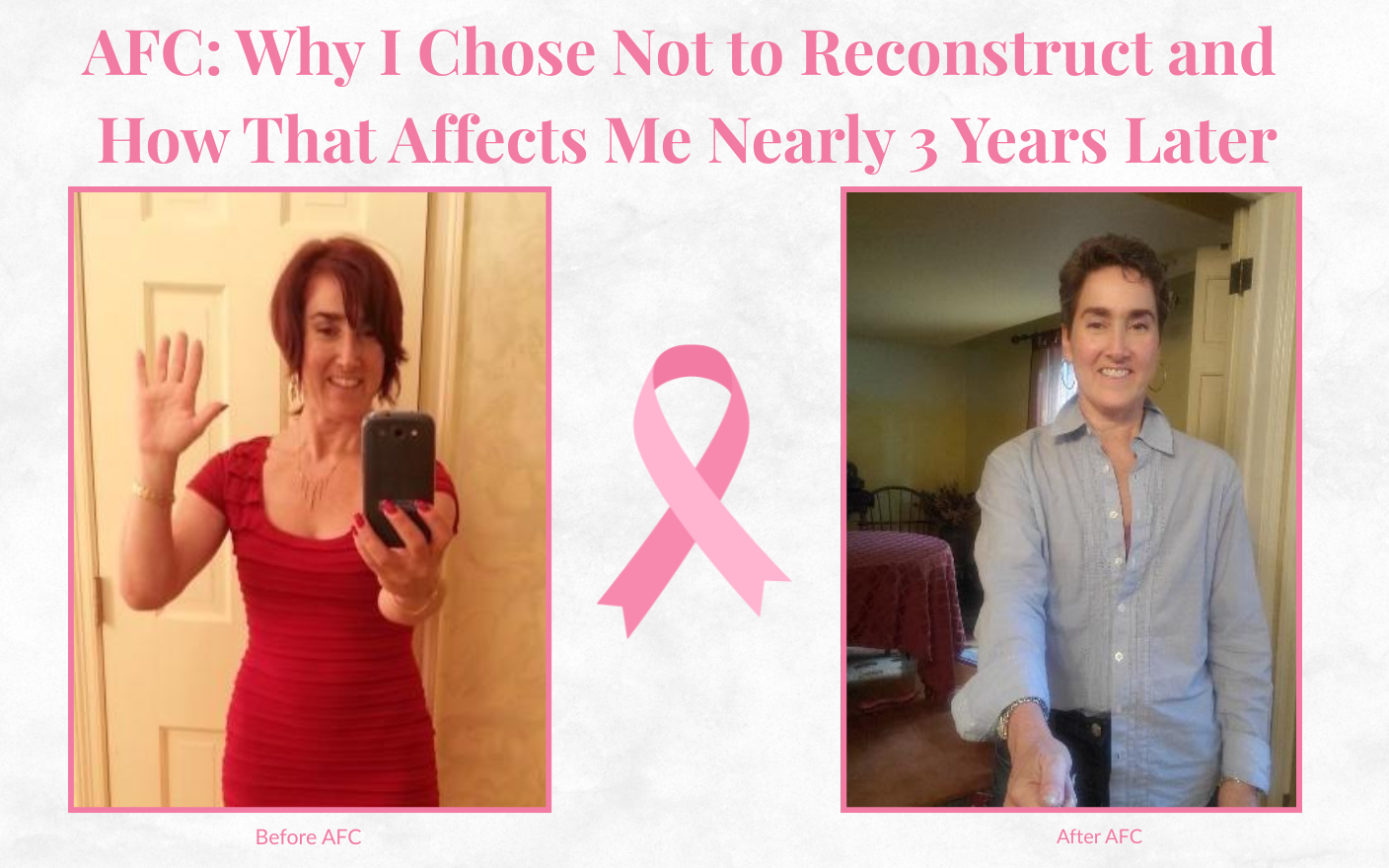
Summer is approaching, which means it’s bathing suit season. I am entering my third summer post-diagnosis, treatment, and surgery for breast cancer. For me, 2022 marks the last summer I was “whole.” And the approaching summer is still pretty much the only time of the year when I’m aware that I’m still adjusting to the “new me.”
You see, as a fit, active person, I used to wear most any kind of bathing suit I wanted, and now I do not.
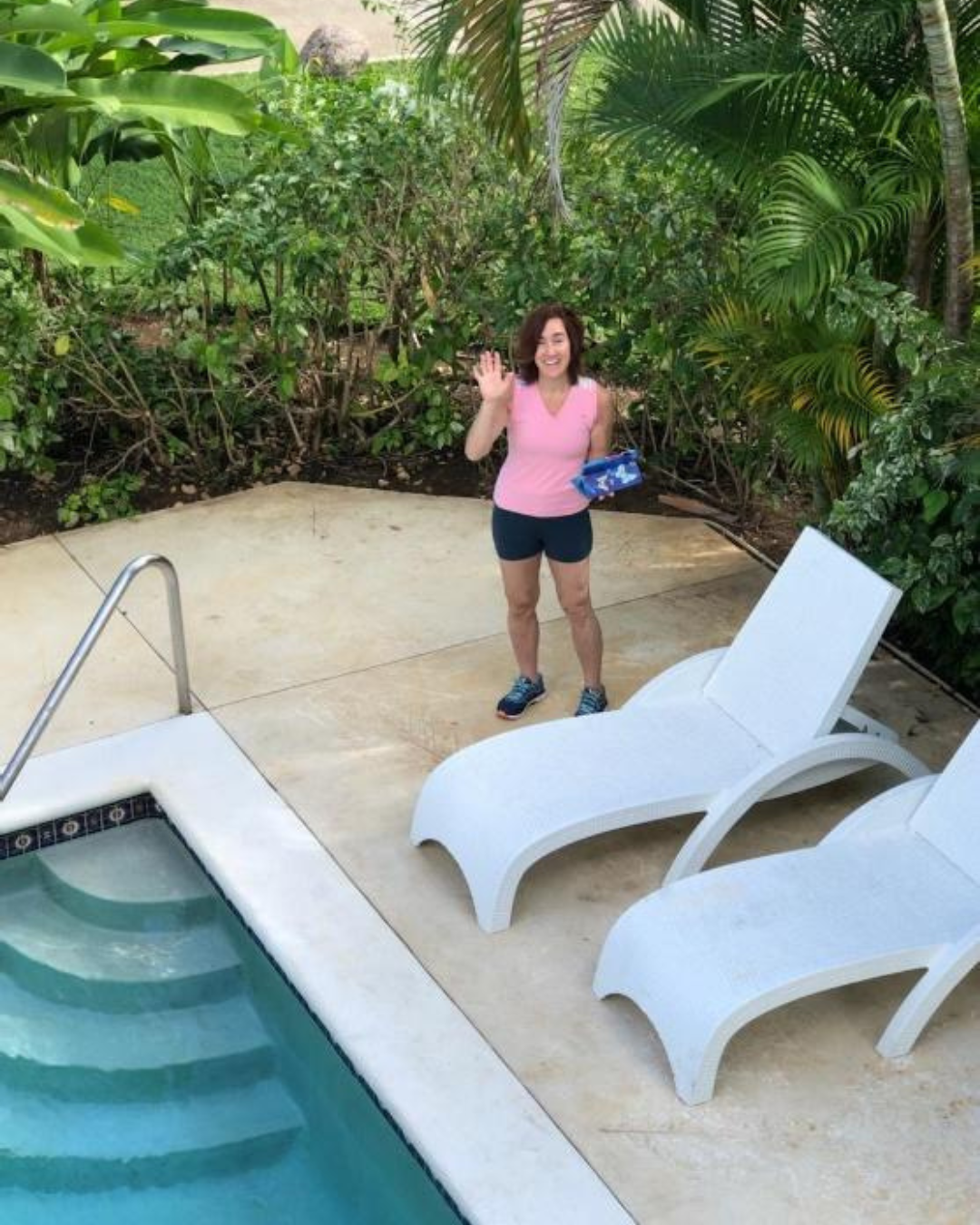

I'm such a fitness nut, I Zoomed in with my instructor while on vacation!
That’s because after learning I would definitely need a mastectomy, I chose not to reconstruct. Instead, I opted for an AFC, Aesthetically Flat Closure, and I am “half-flat” – I still have my unaffected breast and nothing but a scar on my mastectomy side.
Some women like me choose to call themselves by other names: “uniboobers,” “unicorns,” or even “Amazons,” after the Greek mythological all-female warrior culture which removed the right breasts of its archers so that they could better use their weapons.
Being half flat just doesn’t work with all bathing suits anymore, even if I were to choose to use an insert, breast form, or prosthesis. If I’m being honest, that is why thinking about bathing suits can still be a bummer.
Why then, you might wonder, did I choose this outcome for myself?
I deliberated long and hard and did a lot of research before making my decision. I have several reasons why I chose AFC, and I’m sharing my very personal story with you today because I know, just like me, some of you may be confused, scared, and even sad you need to face such a life-altering decision as removing one or both your breasts.
My Situation
When I first received the news of my diagnosis, I thought, “Great! I caught this thing early, I’ll get a little incision, they’ll scoop out the bad stuff, and life will go on!” Little did I know just how wrong I was.
Just because I detected a mass less than a year after my last mammogram, I wasn’t aware that there are many different types of breast cancer, and that they all receive different treatments based on the type.
In my case, though my actual mass was not all that big, it was typed as Triple Negative breast cancer.
Strike One
Triple Negative is very aggressive and demands long, very harsh, and upfront (“neoadjuvant”), chemotherapy treatment.
My surgeon said it was possible that I might be able to get away with only getting a lumpectomy, but it was likely going to be her recommendation that I receive a full mastectomy of my affected breast. She recommended I talk to a plastic surgeon and investigate my reconstruction options. I set up an appointment with the plastic surgeon and reluctantly began my research.
I will be honest:
I didn’t love what I saw on the Internet, and I began talking to other women who I knew who had or chose to remove their breasts due to a breast cancer diagnosis or a high risk of inheriting or developing breast cancer.
After meeting with my medical team, in the three weeks before I was to begin my chemotherapy, I had to have a battery of additional imaging scans and other tests, one of which was a breast MRI.
The MRI revealed that the cancer had spread to my lymph nodes.
Strike Two
I went from a Stage 1 to Stage 2 diagnosis. My treatment wasn’t going to change, but my surgery was going to be more involved.
In the meantime, I began complaining of a new and unusual pain in my affected breast. The doctors couldn’t really explain it, but it quickly got worse as the first week went on.
Eventually, my surgeon performed a punch biopsy of my skin, which revealed a second, and even more rare, type of breast cancer called Inflammatory breast cancer. It is cancer of the breast skin.
Strike Three
My diagnosis was now bumped up to Stage 3, and now a lumpectomy was off the table. I would definitely be having a mastectomy, and all the skin of my breast would be taken along with it. Additionally, I would be having all of my lymph nodes removed because of the Inflammatory diagnosis
Breast Reconstruction: No choice was great for me
My meeting with the plastic surgeon did not go great.
I was told that because of my lean abdomen, I would not be a candidate for typical reconstruction that relies on that area of the body to recreate “the breast mound.” Instead, I would have to go with latissimus flap breast reconstruction.
That is when skin, blood vessels, and tissue are taken from the back and moved to the chest.
I asked about the possible side effects on using my back muscles, and I asked about the surgery and recovery time. Though I was told that “in most cases,” the surgery didn’t affect the use of the back muscles. I didn’t like those odds.
Additionally, if I wanted “symmetry” – both breasts matching one another – the best bet would be to remove my unaffected left breast and reconstruct that as well. The reconstruction surgery would be multi-staged over time and take quite a long time to recover from.
For me, all of this was a lot to take in.
At this point in my story, let me back up and share another piece of prologue.
I’ve already pointed out that I’m an active person. I especially love to be outdoors, and among my passions is mountain biking.
Me, Moab, UT, September 2021
Being on the trails, and riding a mountain bike is my happy place.
In late 2021, I experienced significant pain in my lower back that turned out to be a bulging disk. I began being treated for it, among which included staying off my mountain bike for six months.
SIX MONTHS?!
That was, at the time, a complete tragedy for me.
Then, after this moratorium period has passed, I had only been back on my mountain bike for five rides before receiving my breast cancer diagnosis.
I felt like life was really slamming me up against a wall.
So, sitting there, in that plastic surgeon’s office, I began doing the math:
- I had already been off my bike for six months
- Cancer treatment was going to last another six months, during which I was once again prohibited from mountain biking
- Then I was going to have surgery and have to wait at least six weeks post-surgery before I could begin radiation, which was also part of my treatment
- Radiation was going to last six weeks
- After my skin healed from the radiation, which might take another six weeks, I could begin the process of reconstructive surgery
- That surgery would require time off from riding as well, possibly as long as six more months post-surgery over time.
“Good grief!” I thought. “That’s more than a year and a half more time away from my biking!"
I am 57 years old – even if I were 100% well, how much more time could I even actually ride like I do right now? Sure, there is my idol, North Shore Betty, who at 73 years old is still a bada** mountain biker, but who knows what else I will have to face in this lifetime. I just do not want to wait any longer than I have to to get back on my bike!
I need to return to my happy place as soon as possible!
Understanding AFC
It was around this time that I also reached out to my cousin’s wife. Due to her breast cancer-ravaged family history, in her 40s she had made the decision to prophylactically remove both her breasts.
Because of the reduction in negative side effects, she had wanted to remain flat post-surgery, but the surgeon talked her into an experimental form of reconstruction. Within the year, she had a horrible reaction to the reconstruction – her body rejected the new tissue – and she had to have the reconstructed breasts removed.
She was now flat, and she told me how it affects her life (or not), how she deals with public occasions, and what Aesthetically Flat Closure was.
Once I learned about AFC, I began considering and researching it in earnest. I learned a lot of useful things, for example:
- Though many women have had mastectomies without reconstruction afterwards, that is not the same as AFC. Without AFC, oftentimes the woman is left with ugly scarring, excess remaining tissue or fat, and even permanent discomfort. One woman I know who had a non-AFC mastectomy decades ago says she’s never been able to look at herself in the mirror again since. Do not assume AFC as a given. If you want to ensure an AFC mastectomy, you have to ask for it and/or find a surgeon who is capable of performing it.
- AFCs can often be done at the time of the mastectomy, meaning no additional surgery may be required. I liked the idea of “one and done.”
- Since nothing is being “installed,” like a spacer or implant, with AFC the risk of infection or other complications is also reduced.
- Recovery from AFC generally takes less time than with reconstruction.
- The process of mastectomy cuts the nerves and therefore the entire reconstructed breasts will have no sensation. (There’s a reason the doctors call it a “breast mound.”) Though AFC doesn’t change that, the skin above and below the scar will have sensation. This was important to me.
- I could always reconstruct down the road. Knowing this was an option also helped me decide in favor of AFC.
Imagining a New Me
People who knew I was considering AFC started sending me information and articles about it. The more I read, the more I began leaning towards AFC. I really liked and could relate to what I was learning. I had a lot of trepidation, though.
Could I actually be OK emotionally without one (or both) breasts? Though modest size-wise, to me, they were still an important part of my physique.
Photo of me from 2014 BEFORE my mastectomy
Photo of me during chemo in 2022 BEFORE my mastectomy
Considering not reconstructing made me acknowledge and confront my own vanity head-on, which itself was not easy.
How would I present myself in public?
Would I ever be comfortable going out with my new uneven chest?
Would I have to hide or mask my chest with scarves, flowy shirts, or busy patterned designs forever more?
Would I always want to wear a prosthesis and how would that be?
There were other thoughts going through my mind as well:
Would I still feel attractive?
Would my husband still find me attractive?
How would this affect my sexuality?
Facing cancer requires tremendous courage in it itself, but just how courageous did I think I could be?
In the end, I decided against reconstruction and in favor of AFC.
For me, it was really about just being able to get back to the business of living in joy faster and not wasting any more of my remaining lifetime on surgeries and trying to look a certain way. No amount of reconstruction was going to make me feel like me again, I reasoned, and cancer had already taken things from me that I could do nothing about. I viewed making this bold decision as the way I was taking back control of my life.
I could do this. I am doing this!
Living Half-Flat, 3 Years Later
Photo of me AFTER my mastectomy in 2023, dressed with no insert
Me, teaching a fundrasier cardio movement class for breast cancer in 2023, AFTER my mastectomy
First and foremost, I have no regrets about my decision not to reconstruct.
Every reason I chose this path came to be. I recovered extremely quickly and with zero complications.
I was back on my mountain bike even before I was done with radiation!
Photo of me AFTER my mastectomy, mountatin biking, wearing a prosthesis in 2023
I have been fitted with a custom prosthesis, designed to match my left breast exactly. I have found mastectomy bras I like wearing, and I can even wear some regular bras. I have also discovered a few other bra insert options that work for me sometimes even better than a prosthesis. There are times now when I just go out in public with no insert or prosthesis in because it’s just more comfortable that way, and I have mentally adjusted to not care either.
I have found other half-flat women like me, some of whom never wear a prosthesis and go out in public with tight-fitting shirts.
Their attitude is, “If people are staring at me, it will make them think, and they will quickly figure out that I’m a breast cancer survivor. That’s a good thing because the more people realize just how pervasive breast cancer is among women, the better we’ll all be.”
Talk about bold!
These women have provided me with a lot of inspiration and sense of empowerment. We shouldn’t feel ashamed, embarrassed, or uncomfortable that we lost our breasts – it’s not like any of us asked for this!
And so, as I browse through bathing suits this year, I am looking for one or two that I can wear comfortably as “just me.”
I like bandeau or halter bathing suit tops without any molded cup, which is tough to find in this day and age! I know that dark colors or fun patterns will work best.
I am still on a journey of recovery, but as more time goes by, the more I have embraced my new body. I have a lot to be thankful for, a lot to be proud of.
Me, in a bathing suit top with no insert in 2023, AFTER mastectomy
My AFC Decision is Not for Everyone
These are extremely personal decisions, and every woman has different circumstances and feelings.
Yours are totally valid.
If you’d like more information about aesthetically flat closure, below are some links you can check out. I wish you much luck with whatever surgical option you decide.
Helpful Links:
BreastCancer.org
Not Putting on a Shirt
Flat Closure Now
Stand Tall AFC
One-Breasted Beauties Facebook group
“Some women want flat chests after mastectomy. Some surgeons don’t go along.” Washington Post, June 11, 2022
Aesthetic Flat Closure photo database