

The new year can create many unique feelings for cancer patients. While everyone is out partying, you may not feel very celebratory. While people are wining and dining and enjoying all kinds of fine fare, your tender insides might not tolerate too much. People talk about watching the ball drop, and you may just feel like dropping into bed. New Year’s Eve can be quite melancholy for someone going through cancer treatment at this time of year.
Typical New Year’s resolutions also need not apply. Depending on where a patient is in their cycle of diagnosis, pre-treatment, in-treatment, or post-treatment, what might otherwise be ordinary goals and attempts at behavioral change can go by the wayside.
What is a New Year’s resolution? It is a personal promise to oneself to do (or not do) something. It is conceived in one’s head as a way to improve or change over the previous year. As a cancer patient, it can be challenging to think of, let alone want to make any resolutions because you have other things on your mind: How you’re feeling from day-to-day. How are you going to be when treatment is over? Are you even going to survive this ordeal?!
So much feels out of the patient’s control, so setting goals can seem futile or impossible. From my own personal experience, however, goal setting really is the best thing a cancer patient can do because it’s exactly what’s in your head – your thoughts and attitudes – that you need to latch onto and use to your advantage. This isn’t an easy ask of yourself, but here’s what I did (and continue to do to this day):
1. Use The Serenity Prayer for guidance.
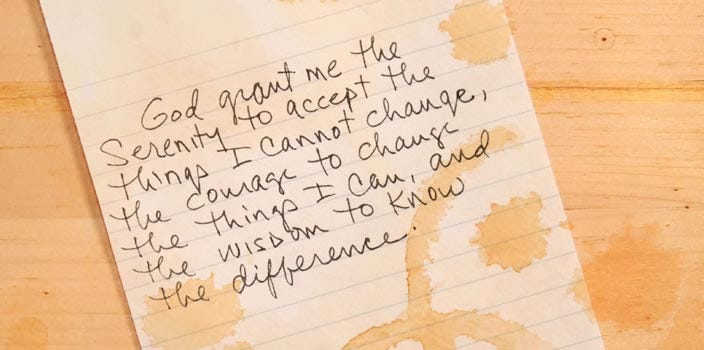

You might already be familiar with this prayer. It’s most often associated with Alcoholics Anonymous, but it really applies to so many of life’s challenging times. I use a modified, agnostic version:
May I find the serenity to accept the things I cannot change,
The courage to change the things I can,
And the wisdom to know the difference.
I think this prayer is a very powerful tool. After I recite these few lines of text, my breathing gets slower and deeper, my mind stops racing, and the way forward draws more into focus. I separate all my swirling thoughts into a mental T-chart: what I can and cannot control. I let go – as best as possible – of the things I cannot change and instead concentrate on what I can. Most of the time during treatment, that had to do with changing my attitude.
2. Play head games with myself.
I admit, I’m a pretty disciplined person with a high degree of self-control. This helps when you’re trying to change your attitude but doing so still takes A LOT of hard work. The work is exponentially harder when you’re undergoing cancer treatment and not even sure about your future. I called upon a technique I use with exercising when I’m not motivated or tackling hard projects: I chunk it out.
This means that in my head, I break things down into smaller and smaller elements until I get to bite-sized nuggets that I’m absolutely confident that I can achieve. For instance, maybe I cannot go all day without having a negative thought. Maybe I cannot even go for an hour! But can I go for five minutes? Yes, I can do that. I can do that even more easily by finding something to distract myself – the more challenging that other task is, the more likely I am to be distracted from my negative thought. Do this often enough, and I can even establish an expectation about how long my attitude is not going to be negatively affected. You can even turn a practice like this into a resolution: Next year, I am going to spend at least X time per day distracting myself from negative thinking!
And guess what, in the process of distracting yourself, you might end up accomplishing some kind of other major thing you’ve been putting off for weeks, months, or even years -- a double bonus!!
3. Practice positive affirmations.
I believe that positive affirmations are probably THE key to changing an attitude and keeping it changed. They are also an easy technique to setting New Year’s resolutions. I used to struggle to understand positive affirmations. Receiving a cancer diagnosis, however, crystallized positive affirmations for me. A positive affirmation is when you articulate something you want as if it’s already happened. The idea is that if it’s already happened, then it must be so.
When creating positive affirmations, you must remove all words that make your affirmation neither definitive nor declarative. Strike words like “will,” “can,” “might,” and “may” from your affirmation. For instance, instead of making your positive affirmation, “After my treatment, I will be cancer free,” your affirmation needs to be “After my treatment, I am cancer free.”
You may say it only in your head, or you may say it aloud. You may choose to keep it private, or you may choose to share it with others. You may have only one or two positive affirmations, or you may have many. Repeat your positive affirmations over and over again, as many times as you need to until they become the reality in your head…which then manifests into an actual real-world reality.
4. Write stuff down.
I may be biased because I’m a writer, but almost every goal-setting technique talks about writing down your goals to make them a reality. When you’re dealing with cancer, you have even more reason to write stuff down. You’re not just trying to develop resolutions for the year to come – you’re coping with so many things going into, on in, and coming out of your head. Your own thoughts, information being told to you by doctors, loved ones and strangers alike offering suggestions, solutions, advice, anecdotes, and help. Are you still working through treatment? You’ve got that to juggle. Are you raising kids? That’ll take up at least half your brain right there!
During cancer treatment, your head may get muddled or foggy. They don’t call it “chemo brain” for nothing! Writing things down is good discipline in any situation, but especially during treatment, you’re going to need to get stuff out of your head and onto a different medium, whether that’s paper or an electronic document or note somewhere. It will be therapeutic.
And while you’re at it, at this time of year, you can use your written musings to help you develop some reasonable resolutions for the year to come.
Still need some help? I’ll let you in on my resolutions, which also happen to be part of my positive affirmations. They’re not earth-shattering goals. These are all about creating the attitude I want, which is the part I can control. Feel free to copycat them if they work for you, too.
- I am living with joy.
- I am breathing with relief and celebrating the day.
- I remain cancer-free.